
Brattle Analysis Supports MISO’s Updated Value Proposition Framework, Quantifying $7.6 Billion in Annual Net Benefits from Regional Coordination
The Midcontinent Independent System Operator (MISO) has released its 2025 Value Proposition Report, finding that its markets, regional transmission planning, and coordinated operations generated an estimated $7.6 billion in net benefits in 2025 for MISO members and the 45 million customers they serve. The analysis finds that MISO members receive approximately $21 in benefits for every dollar spent on MISO, with cumulative benefits surpassing $57 billion since 2007.
The report reflects the most significant update to MISO’s Value Proposition methodology since 2007. MISO engaged The Brattle Group to conduct an independent review of the economic framework and valuation methodology used to assess the long-term economic value of benefits created by the regional transmission organization (RTO). Brattle supported MISO in updating its estimation approaches to better align with emerging grid realities, including tighter reserve margins, a shifting resource mix toward higher levels of renewable and battery resources, and more challenging system flexibility needs.
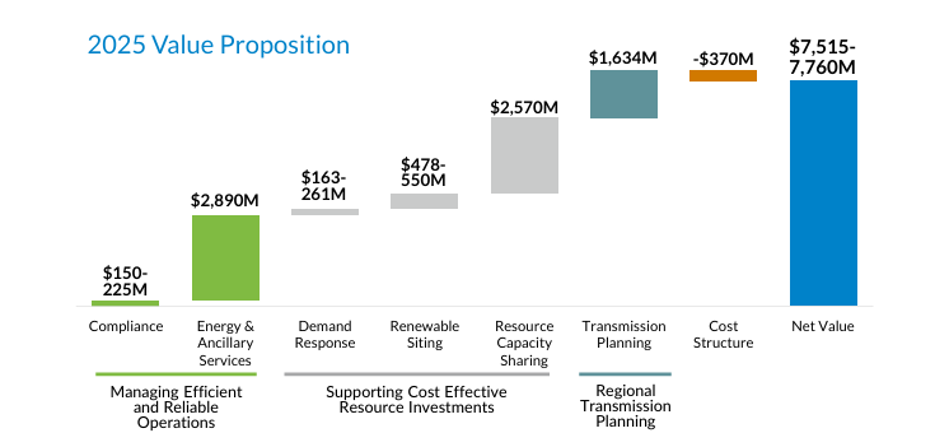
Source: MISO 2025 Value Proposition, page 11.
The 2025 Value Proposition confirms that the foundations of regional market value remain familiar: coordinating generation commitment and dispatch across a large and diverse footprint, sharing reserves and capacity, enabling economic trade, and planning and using the transmission system more efficiently to serve the region. However, the power system itself has changed substantially. Rapid load growth, a changing resource mix, tighter reserve margins, greater reliance on weather-dependent generation, and increasingly complex reliability and balancing needs mean that the ways regional coordination creates value, and the methods used to measure that value, also need to evolve.
Among the most significant changes in the updated Value Proposition estimation framework developed by Brattle include:
- Regional transmission planning is now explicitly valued. The new framework estimates approximately $1.6 billion in 2025 benefits from MISO’s collaborative regional transmission planning process, incorporating benefits associated with its Multi-Value Project and Long-Range Transmission Planning portfolios. Those benefits will grow over time as additional regional projects enter service.
- Energy and ancillary services benefits are assessed using a more sophisticated, market-informed methodology. Rather than assuming normal operating conditions, Brattle developed the updated approach using a granular five-minute simulation of real-world market operational data obtained from MISO, comparing the costs of dispatching the fleet with and without MISO. The enhanced simulation better reflects factors such as fuel prices and offers, generator and transmission outages, extreme weather, forecast uncertainty, and real-time system balancing needs. MISO estimates approximately $3.1 billion in 2025 benefits from centralized commitment, dispatch, ancillary services, and related operational efficiencies.
- Resource investment benefits have been refined to better reflect MISO’s seasonal resource adequacy framework, tighter reserve margins, capacity import costs, resource mix shifts, and current estimates of the cost of new capacity.
The updated methodology also illustrates how much the measurement of regional value has changed. When MISO recalculated its 2024 results using the new framework, the estimated net benefits increased from approximately $5.1 billion under the previous methodology to $7.7 billion, largely reflecting a more comprehensive treatment of energy and ancillary services and the addition of regional transmission planning benefits. MISO cautions that the results calculated under the two methodologies should therefore not be compared directly for some benefit categories.
Looking ahead, MISO projects that the economic value of regional coordination will continue to increase as load grows and new regional transmission infrastructure enters service. Its Forward View estimates net benefits will rise to approximately $16 billion in 2035 and $24 billion in 2045.
The findings underscore an increasingly important feature of the changing electricity system: as utilities confront faster load growth, a more diverse generation fleet, and increasingly complex reliability needs, the ability to coordinate resources, markets, and transmission across a broad regional footprint becomes even more valuable.
Brattle consultants previously joined MISO representatives to present the proposed updates to stakeholders during a February 2026 Value Proposition Workshop. Brattle team members contributing to the review and development of simulation methods include Dr. Kathleen Spees, Johannes Pfeifenberger, Ragini Sreenath, Joe DeLosa, Serena Patel, Sarah Sofia, and Sebastian Rotella.
Read MISO’s full 2025 Value Proposition Report and Brattle’s presentation below:
View 2025 Value Proposition Report
View Proposition Workshop Presentation