
Heating Sector Transformation in Rhode Island: Pathways to Decarbonization by 2050


Heating Sector Transformation in
Rhode Island
Pathways to Decarbonization
by 2050
Prepared FOR
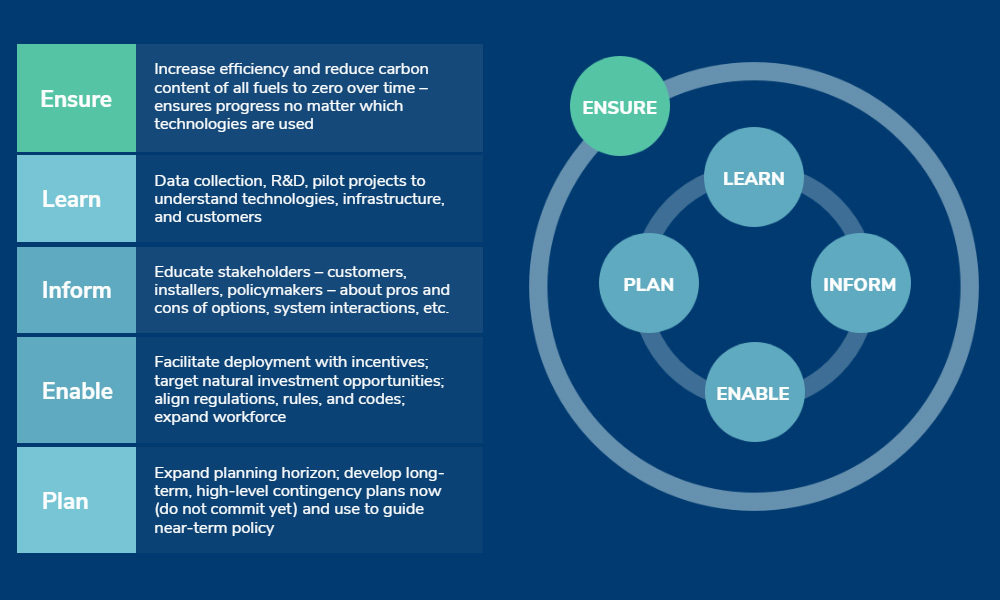
Policy support will be vital to ensuring that the transition to decarbonized heating happens fast enough to meet mid-century decarbonization targets. Over the next 10 years, policy to support the transformation of the heating sector should focus on ramping up and getting ready, all in the context of ensuring progress – regardless of which mix of solutions customers choose.
As part of Rhode Island’s commitment to economy-wide decarbonization, this study examines potential solutions that can transform the state’s heating sector. Although it’s not yet clear which specific pathway will best provide decarbonized heat, the state can make substantial progress in the next decade to replace the fossil fuels that it currently uses for heating.
There are many solutions for decarbonizing the heating sector, but they fall into three broad categories:
- Reducing energy needs by improving building energy efficiency
- Replacing existing fossil heating fuels with carbon-neutral renewable gas or oil
- Replacing existing fossil-fueled boilers with furnaces with electric ground source heat pumps (GSHPs) or air source heat pumps (ASHPs) powered by carbon-free electricity
While cost-effective energy efficiency retrofits will reduce both emissions and costs to consumers, they can’t come close to eliminating the need for heat in hundreds of thousands of existing buildings in the state. Virtually all of Rhode Island’s buildings will need to adopt a solution to provide decarbonized heat, such as electrification with heat pumps or decarbonized fuels.
plan
ENABLE
inform
Learn
ensure
THEMES TO GUIDE EARLY
POLICY RECOMMENDATIONS
Expand planning horizon; develop long-term, high-level contingency plans now (don't commit yet) and use to guide near-term policy
Plan
Facilitate deployment with incentives; target natural investment opportunities; align regulations, rules, and codes; and expand workforce
Enable
Educate stakeholders – customers, installers, policymakers – about pros and cons of options, system interactions, etc.
Inform
Data collection; R&D; and pilot projects to understand technologies, infrastructure, and customers
Learn
Increase efficiency and reduce carbon content of all fuels to zero over time – ensures progress no matter which technologies are used
Ensure
Considering the various decarbonized heating solutions, what might a representative consumer’s energy wallet spending look like in 2050? Compared to 2020, heating costs may increase, particularly for current natural gas customers, but any heating cost increases could be at least partially offset by cost decreases elsewhere in the energy wallet. This includes savings through energy efficiency and in transportation energy costs.
TOTAL ANNUAL ENERGY WALLET COMPARISON FOR REPRESENTATIVE CONSUMER
2020 VS 2050 MIXED SCENARIO, 2018$

What can a more balanced adoption scenario achieve? The Mixed Scenario assumes that by 2050, decarbonized heating will be provided by:
-
66%: Electric heat pumps (33% each by ASHPs and GSHPs)
-
27%: Renewable gas – which loses 50% of volume relative to today
-
7%: Renewable oil – which loses 80% of volume relative to today
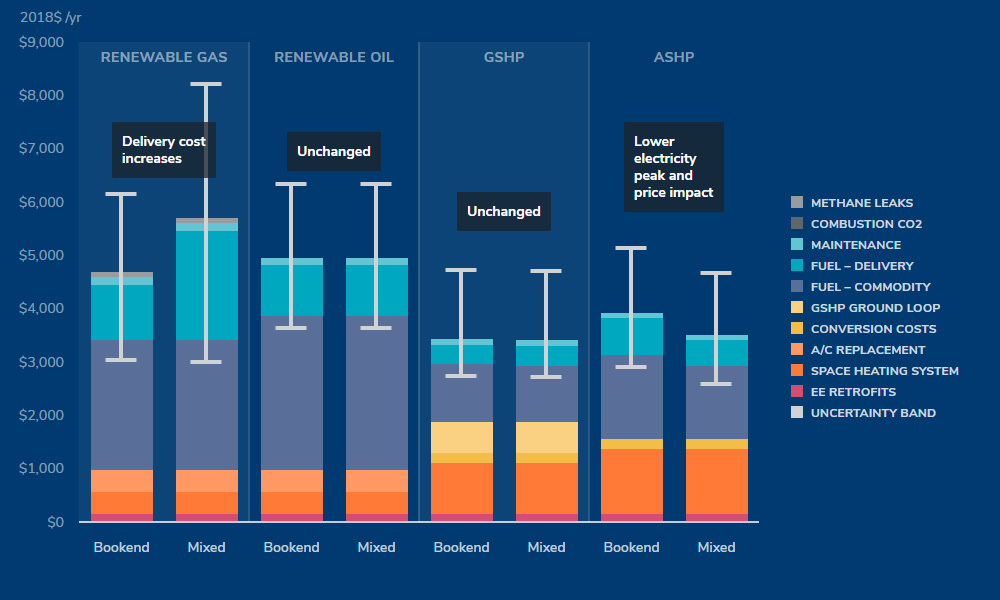
This suggests that using less gas for heating can increase the delivered cost, as the essentially fixed costs of the delivery system are spread across less total gas usage. Also, ASHPs' impact on electricity prices is less extreme at lower penetration levels.
ANNUALIZED COST OF SPACE HEATING IN 2050,
REPRESENTATIVE SINGLE-FAMILY HOME BOOKEND VERSUS MIXED SCENARIOS, 2018$
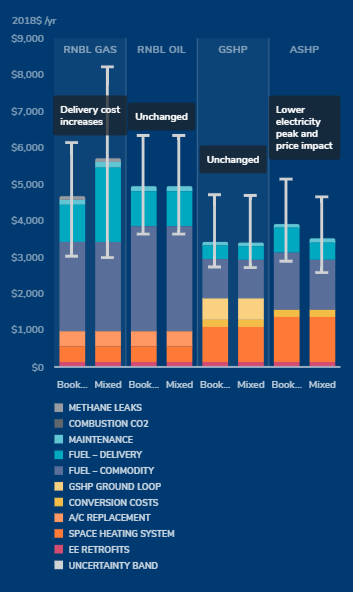
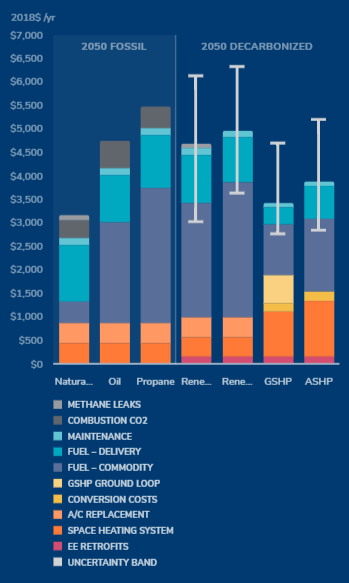
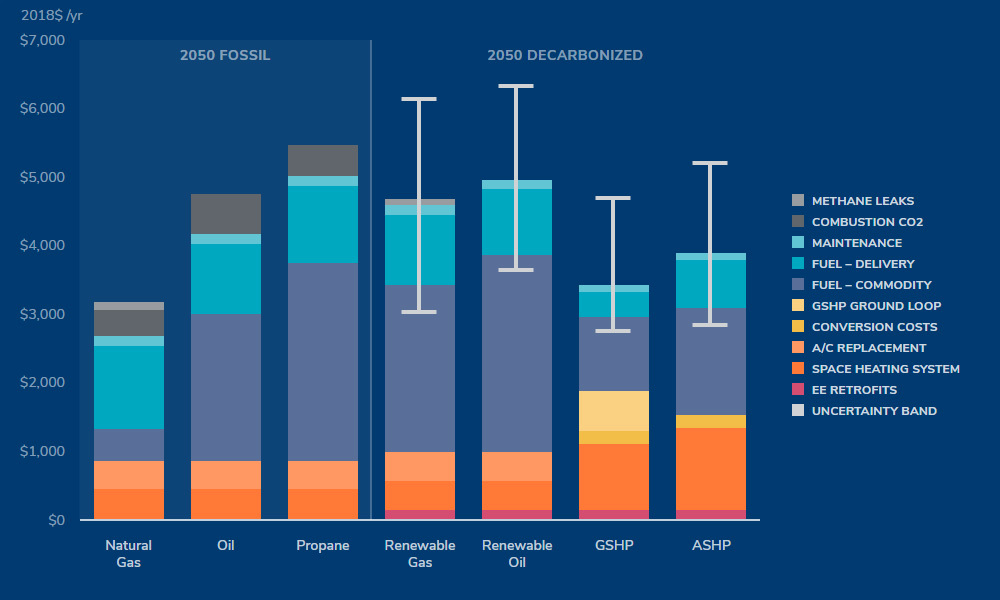
What is the projected range of average annual heating costs in 2050 for a representative existing single-family home in Rhode Island? This figure compares the cost of existing fossil fuels (on the left) vs. alternative decarbonized heating solutions (on the right), using a set of “bookend” scenarios that assume for each decarbonized technology that this technology provides all heat across New England. It compares cases where fuels (gas and oil, but now renewable) continue to provide heat; or for electric heat pumps, assumes 100% adoption of GSHPs or ASHPs, to capture the potential impacts of these technologies on the region’s overall energy systems. The uncertainty bands show that cost uncertainties are large for each of the decarbonized solutions, and are largely overlapping. This suggests that it is too soon to rule out any of these solutions. Early progress will help to resolve this uncertainty.
ANNUALIZED COST OF SPACE HEATING IN 2050, REPRESENTATIVE SINGLE-FAMILY HOME,
BOOKEND SCENARIOS, 2018$

Rhode Island can promote this transformation through a range of policy options that focus on learning and informing – to help address inherent uncertainties – and by taking steps to enable and plan for the transformation. These steps will include creating incentives for customers to decarbonize, and coordinating the many organizations and consumers who will be involved in the transformation, while ensuring that the state protects vulnerable populations and avoids unintended consequences.
For more information,
please reach out to the study authors.
authors
about brattle
The Brattle Group answers complex economic, finance, and regulatory questions for corporations, law firms, and governments around the world. We are distinguished by the clarity of our insights and the credibility of our experts, which include leading international academics and industry specialists. Brattle has 500 talented professionals across North America, Europe, and Asia-Pacific.


Jürgen Weiss
Principal
The Brattle Group
Dean Murphy
Principal
The Brattle Group