Report
January 29, 2026
Options for an Enduring Financial Transmission Rights Model for Alberta
Prepared for Alberta Electric System Operator (AESO)
For the Alberta Electric System Operator, Brattle consultants reviewed international experience with financial transmission rights (FTRs) and developed a range of alternative models for managing congestion-related risks in the context of Alberta’s upcoming transition to an optimally-planned transmission system and the introduction of locational marginal pricing (LMP).
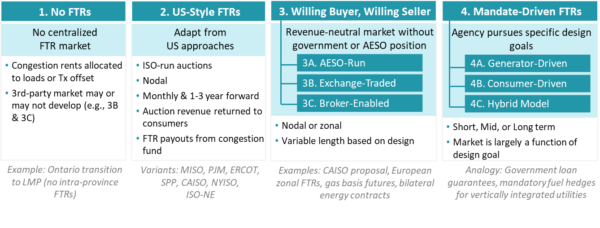
The alternative models are summarized in the figure below. They include:
- No Centralized FTRs is the simplest solution, and the option to beat from an efficiency perspective. Without FTRs, investors will face efficient LMP-based incentives guiding the type and location of resources to build. For example, developers facing full LMP risk may opt to pursue renewables in locations with better transmission access, incentivize retrofitting constrained renewables with batteries, and incentivize projects that co-locate supply with demand. Further, customers are relatively protected from congestion risks considering that they are settled on a load-weighted average price and that congestion rents will be returned entirely to transmission ratepayers. The primary downside of this option is the lack of a liquid platform for offloading congestion risk (though the option maintains the opportunity for third-party trading platforms and bilateral markets to develop and independently support congestion hedging).
- US-Style FTRs is included in this paper primarily to offer a benchmark comparison and illustrate experience with several design elements, but is unlikely to serve the needs of the future Alberta market considering the substantial differences in Alberta’s historical context and identified performance gaps. The US FTR market designs were aligned to enable allocation of congestion rents to protect utilities with complex self-supply and contract books in the transition to large RTO footprints, addressing issues that are less relevant in Alberta’s context. Further, the performance gaps in the US markets result in a relatively poor value proposition to both consumers and new generators. The main advantages of the US approach are the high liquidity and market transparency offered over an outlook of a few years, though the value created by that transparency appears low compared to the scale of profits extracted by financial participants.
- Willing Buyer, Willing Seller variants offer the appealing feature of being the most market-oriented approaches that can most efficiently reallocate risks to financial entities that can best manage those risks. These voluntary markets come in several varieties and could be operated by the ISO (Option 3A), by a commodity exchange (Option 3B), or by brokers (Option 3C). Willing Buyer, Willing Seller variants offer all of the efficiency benefits of LMP-based locational pricing signals, ensure that all congestion rents are returned to the ratepayers funding the transmission system, and offer incremental hedging opportunities. The downside of Option 3 is the possibility that the markets could be thin on liquidity, in which case they would offer minimal advantages compared to a No Centralized FTRs model.
- Mandate-Driven FTR variants offer the opportunity to pursue specific design goals, but should be considered only in service of well-articulated goals. Enumerated examples include support for generator investments (Option 4A), hedging customers from congestion risks and/or allowing a subset of customers to reallocate access to congestion rent refunds in ways that better align with individualized risks (Option 4B), or a mixture of these goals (Option 4C). The downside of the Option 4 variants is the complexity for a government agency in making decisions on the level of risk that should be borne and by who, with consumers bearing the net costs and tail risks of any FTR sales. Further, if the FTRs offered are underpriced or offer excess protection from congestion risks, the result could be to subsidize generators for making inefficient investment decisions (e.g., by over-building renewables into an already over-saturated part of the grid). For these reasons, the Option 4 variants should also be considered only if the government agencies in question have a clear mandate on the role and purpose of the mechanism, sufficient resourcing to effectively assess and manage the risks and incentives being introduced, and incorporate the recommendations to protect consumers from excess risk and cost.
The alternative congestion management options illustrate a wide variety of design alternatives, policy tradeoffs across the models, and the importance of specifying clear design objectives prior to developing an enduring FTR mechanism.